
Abeero Home · Bedding guides
Flat Sheets vs Fitted Sheets: Functions and Sizing
A fitted sheet covers the mattress beneath you and uses shaped corners or elastic to hold its position. A flat sheet is an unshaped rectangle, commonly used as a top sheet above you. Whether you use that top layer is a preference; its dimensions determine drape and tuck, while fitted-sheet compatibility requires the actual mattress footprint and covered depth.
[1] Casper · Casper describes fitted sheets as elastic-corner mattress coverings and flat sheets as larger rectangles with fabric for tucking. Basic functions only, not supplier-specific fit or retention guarantees.
[2] Abeero Home · Abeero Home’s setup section places the fitted sheet on the mattress and the flat sheet on top. Basic layering, not a documented depth test.
In this guide
Two pieces, two different jobs
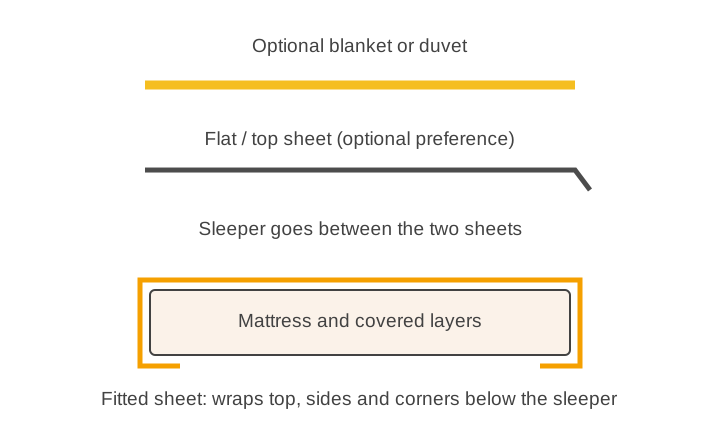
The fitted sheet surrounds the mattress top and corners, so the sleeper lies above it. A flat sheet used as a top sheet lies above the sleeper and below a blanket or duvet. Abeero Home’s basic setup guidance places the fitted layer first and the flat layer above it. The diagram shows that familiar arrangement without claiming any particular bed has been tested.
[1] Casper · Casper describes fitted sheets as elastic-corner mattress coverings and flat sheets as larger rectangles with fabric for tucking. Basic functions only, not supplier-specific fit or retention guarantees.
[2] Abeero Home · Abeero Home’s setup section places the fitted sheet on the mattress and the flat sheet on top. Basic layering, not a documented depth test.
A flat sheet can be tucked or left with some loose drape. Its lack of fitted corners means its placement is adjustable, but it does not acquire a documented fitted-sheet range by being tucked under the mattress. Keep the decision about comfort and arrangement separate from a claim that a product is correctly sized for a fitted role.
Decide whether you want a top sheet
Some people like a separate sheet above them; others prefer a duvet cover or another top layer without one. Decide based on your arrangement, handling preferences and care routine. This guide does not declare a top sheet necessary, promise that either arrangement sleeps cooler, or treat one preference as more hygienic without appropriate evidence.
Editorial reasoning: The layout can include or omit an additional sheet above the sleeper. Neither arrangement establishes health, cooling or hygiene superiority; care requirements remain separate.
If you omit a top sheet, the items above you still need care according to their own labels. If you include it, you have another item to wash, dry, fold and store. A top sheet does not make a blanket or duvet cover exempt from care. Check that each chosen layer is useful rather than counting unused pieces as a benefit automatically.
A size name does not specify one flat-sheet rectangle
| Item | Inches, width × length | Centimeters, calculated |
|---|---|---|
| Brooklinen published chart [3] Brooklinen · Brooklinen lists Full flat sheets 86 × 98 and Queen 92 × 104 inches. Dimensions belong to Brooklinen, not Abeero Home or a universal standard. | 92 × 104 | 233.68 × 264.16 |
| Casper guide reference [1] Casper · Casper gives approximately 96 × 102 inches for Queen and notes that flat-sheet dimensions vary by brand/material. A different supplier reference demonstrates why the size name does not determine one rectangle. | Approximately 96 × 102 | Approximately 243.84 × 259.08 |
These are supplier examples, not Abeero Home specifications. Centimeters multiply inch values by 2.54; converting does not increase the precision of an approximate source.
Suppliers publish different rectangles under the same bed-size name. The table shows a wider but shorter Casper reference beside Brooklinen’s narrower but longer chart entry. That is enough to require checking actual product dimensions; it does not prove why a manufacturer chose its cut or establish one optimal industry-wide size.
For a fitted sheet, ask about the intended mattress footprint and covered-depth limit. For a flat sheet, ask which dimension is width across the bed and which is length from head to foot. If a listing supplies two numbers without orientation, seek confirmation instead of silently rotating them to make the tuck result look better.
Overhang is not the same as usable tuck
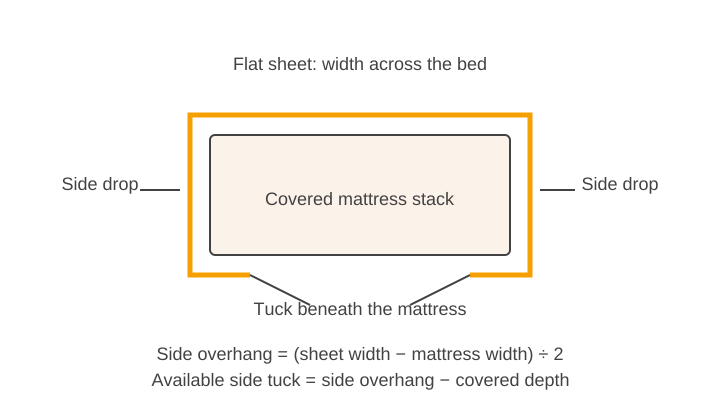
For a centered flat sheet, subtract mattress width from sheet width and divide by two to get side overhang from the top edge. That fabric must first cover the mattress stack’s vertical depth. Only the remainder is available for side tuck. A negative remainder means shortage against the assumed straight-sided path, not negative fabric to be hidden by rounding.
Calculation basis: Side tuck = (sheet width − mattress width) ÷ 2 − covered depth. Foot tuck = sheet length − mattress length − head allocation − covered depth. Negative values are shortfalls; straight edges, no gathering and a stated head allocation are assumed.
Hypothetical example: A 92 × 104-inch sheet on a Queen
- Mattress footprint:
- 60 × 80 in
- Covered depth:
- 12 in
- Sheet and head allocation:
- 92 × 104 in; 4 in allocated beyond the head edge
- Side overhang = (92 − 60) ÷ 2 = 16 inches.
- Available side tuck = 16 − 12 = 4 inches.
- Foot tuck = 104 − 80 − 4 − 12 = 8 inches. The stated head allocation is used once.
This idealized placement leaves 4 inches per side and 8 inches at the foot. Compare with your preferred tuck; neither number verifies the fitted sheet.
Calculation basis: Side tuck = (sheet width − mattress width) ÷ 2 − covered depth. Foot tuck = sheet length − mattress length − head allocation − covered depth. Negative values are shortfalls; straight edges, no gathering and a stated head allocation are assumed.
The head allocation is your explicit placement input—not an automatic equal split of extra length. If you move more sheet toward the head, you leave less at the foot. An off-center sheet also changes each side’s allocation. The drop-and-tuck tool uses stated assumptions so you can change them instead of accepting an unexplained recommendation.
Check actual contents and care each piece
Before choosing or reusing a set
- Confirm the exact size/variant includes the pieces you want; do not assume four pieces.
- Check the fitted sheet’s intended footprint and supported covered depth.
- Record flat-sheet width, length, orientation and desired placement.
- Check included pillowcase sizes and counts against your pillows.
- Read each item’s current care label and compare instructions before washing together.
- Keep unknown specifications unconfirmed rather than borrowing another brand’s chart.
Follow the actual care labels. Casper’s cleaning guidance explicitly points readers to label instructions; it does not supply a universal wash temperature for every sheet. Do not assume flat and fitted pieces can share a cycle solely because both are called sheets. Check temperature, drying, bleach and other restrictions on the actual items, and avoid unsupported chemical recipes.
[1] Casper · Casper’s cleaning section says to follow the washing instructions on the label. Label-first guidance only; no universal settings or product-specific durability claims.
Use the contents checker before selecting a bundle, then the drop-and-tuck tool for the flat piece you actually have. Abeero Home’s dimensions and counts must come from the exact reviewed variant, not the examples above. Confirm the fitted sheet’s intended footprint and supported depth separately from the flat sheet dimensions, then choose your favorite color and quantity. Any undocumented fit limits still need confirmation.
Put this into practice
- Calculate side drop and foot tuck for your flat sheet
Enter actual sheet dimensions, covered depth and head allocation; see both usable tuck and shortfalls.
- Check which pieces the exact set includes
Separate fitted sheet, flat sheet and pillowcase counts without assuming every size is a four-piece set.
Common questions
Which sheet goes below the sleeper?
The fitted sheet covers the mattress below you. In a top-sheet arrangement, the flat sheet goes above you and below another top layer.
[1] Casper · Casper describes fitted sheets as elastic-corner mattress coverings and flat sheets as larger rectangles with fabric for tucking. Basic functions only, not supplier-specific fit or retention guarantees.
[2] Abeero Home · Abeero Home’s setup section places the fitted sheet on the mattress and the flat sheet on top. Basic layering, not a documented depth test.
Do I have to use a flat top sheet?
No requirement is established here. Choose the arrangement you prefer and care for all included layers according to their actual labels.
Editorial reasoning: The layout can include or omit an additional sheet above the sleeper. Neither arrangement establishes health, cooling or hygiene superiority; care requirements remain separate.
Why are Queen flat sheets different sizes by brand?
The name does not prescribe one product rectangle. Brooklinen lists 92 × 104 inches; Casper’s guide gives approximately 96 × 102. Check the exact dimensions rather than inferring them.
[3] Brooklinen · Brooklinen lists Full flat sheets 86 × 98 and Queen 92 × 104 inches. Dimensions belong to Brooklinen, not Abeero Home or a universal standard.
[1] Casper · Casper gives approximately 96 × 102 inches for Queen and notes that flat-sheet dimensions vary by brand/material. A different supplier reference demonstrates why the size name does not determine one rectangle.
Is all side overhang available for tucking?
No. Subtract covered mattress depth from side overhang first. With straight sides, a 16-inch overhang on a 12-inch stack leaves 4 inches for side tuck.
Calculation basis: Side tuck = (sheet width − mattress width) ÷ 2 − covered depth. Foot tuck = sheet length − mattress length − head allocation − covered depth. Negative values are shortfalls; straight edges, no gathering and a stated head allocation are assumed.
Does every sheet set contain a flat sheet and two cases?
Do not assume that. Check the exact variant’s documented included pieces and sizes; a set name or piece-count total alone is insufficient.
Sources
- The Ultimate Bed Sheet Sizes Guide (with Sizing Chart)
Casper · general guidance · Retrieved · Reviewed
- Casper describes fitted sheets as elastic-corner mattress coverings and flat sheets as larger rectangles with fabric for tucking.
- Casper gives approximately 96 × 102 inches for Queen and notes that flat-sheet dimensions vary by brand/material.
- Casper’s cleaning section says to follow the washing instructions on the label.
Read article text in full gateway markdown. Fit guarantees, health/comfort claims, universal pocket limits and automatic shrinkage assumptions are not adopted.
- Affordable Best-Quality Bedding | Abeero Home
Abeero Home · background · Retrieved · Reviewed
- Abeero Home’s setup section places the fitted sheet on the mattress and the flat sheet on top.
Homepage read. Testimonials, retention guarantees, discounts, customer counts, health/cooling claims and general care settings are not adopted as exact-variant evidence.
- What are the dimensions of your Bedding products?
Brooklinen · comparative example · Retrieved · Reviewed
- Brooklinen lists Full flat sheets 86 × 98 and Queen 92 × 104 inches.
Published product chart only. All examples belong to Brooklinen, not Abeero Home; the third fitted dimension is listed depth, not independent testing or a universal allowance.