Abeero Home · Bedding guides
Percale vs Sateen: Weave, Feel and Care
Percale and sateen describe weave constructions, not fiber ingredients. Cotton percale is commonly described as crisp and matte; cotton sateen as smooth with sheen and drape. Those are useful starting profiles, not guarantees for every finished sheet. Check the actual fiber label, finish and care instructions, and choose the surface you prefer rather than treating either weave as universally superior.
[1] Brooklinen · Brooklinen describes its cotton percale as one-over-one-under with a crisp matte profile. Manufacturer example, not all fabrics or independent thermal evidence.
[1] Brooklinen · Brooklinen describes its sateen as four-over-one-under with a smooth surface and subtle sheen. One illustrated repeat, not the only satin-family construction or a product performance test.
[2] Cotton Incorporated / CottonWorks · CottonWorks describes percale with a crisper hand and sateen with a smooth silky-like hand. Cotton construction profiles, not a tactile examination of Abeero Home or every supplier.
Editorial reasoning: The schematic rearranges yarn crossings without identifying chemistry. Preference examples assign no quality, cooling or durability score; current labels govern care.
In this guide
See the yarn crossings—not a fiber ingredient list
[1] Brooklinen · Brooklinen describes its cotton percale as one-over-one-under with a crisp matte profile. Manufacturer example, not all fabrics or independent thermal evidence.
[1] Brooklinen · Brooklinen describes its sateen as four-over-one-under with a smooth surface and subtle sheen. One illustrated repeat, not the only satin-family construction or a product performance test.
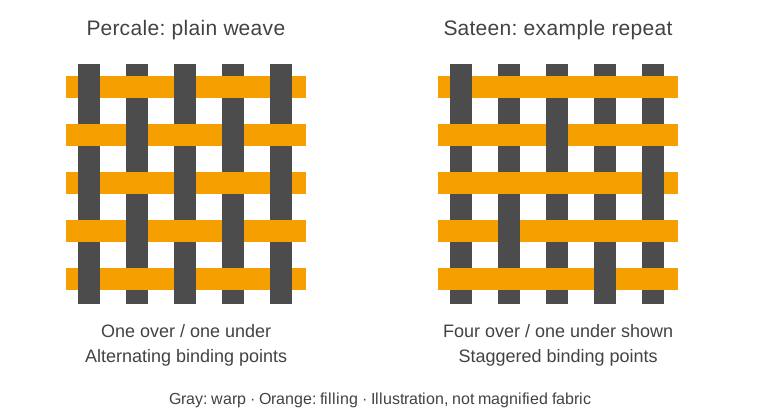
In the plain-weave example, a filling yarn goes over one warp yarn and under the next, with the adjacent row alternating that order. Brooklinen describes this one-over-one-under structure for its percale. The diagram enlarges the crossings so they are readable; it does not depict actual yarn thickness or magnification.
[1] Brooklinen · Brooklinen describes its cotton percale as one-over-one-under with a crisp matte profile. Manufacturer example, not all fabrics or independent thermal evidence.
The sateen example shows longer exposed yarn spans, called floats, between binding points. Brooklinen describes its sateen as four-over-one-under. The original diagram uses that repeat with staggered binding positions; it illustrates one pattern rather than claiming every sateen fabric has precisely the same repeat.
[1] Brooklinen · Brooklinen describes its sateen as four-over-one-under with a smooth surface and subtle sheen. One illustrated repeat, not the only satin-family construction or a product performance test.
Neither pattern identifies whether the yarn is cotton or another fiber. “Cotton sateen” supplies both a composition category and a construction description; “sateen” alone does not supply a cotton percentage. Likewise, “silky-like” describes a feel comparison and does not establish silk content. Read the actual composition independently.
[2] Cotton Incorporated / CottonWorks · CottonWorks describes percale with a crisper hand and sateen with a smooth silky-like hand. Cotton construction profiles, not a tactile examination of Abeero Home or every supplier.
Editorial reasoning: The schematic rearranges yarn crossings without identifying chemistry. Preference examples assign no quality, cooling or durability score; current labels govern care.
Use feel profiles as starting points, not promises
| Item | Percale starting profile | Sateen starting profile | Qualification |
|---|---|---|---|
| Hand / surface feel [2] Cotton Incorporated / CottonWorks · CottonWorks describes percale with a crisper hand and sateen with a smooth silky-like hand. Cotton construction profiles, not a tactile examination of Abeero Home or every supplier. | Crisper | Smoother, silky-like | CottonWorks profiles; finish and product vary |
| Appearance [1] Brooklinen · Brooklinen describes its cotton percale as one-over-one-under with a crisp matte profile. Manufacturer example, not all fabrics or independent thermal evidence. [1] Brooklinen · Brooklinen describes its sateen as four-over-one-under with a smooth surface and subtle sheen. One illustrated repeat, not the only satin-family construction or a product performance test. | Matte | Subtle sheen | Brooklinen examples, not a gloss measurement |
| Drape [2] Cotton Incorporated / CottonWorks · CottonWorks identifies yarn, weight, construction and finishing as multiple contributors to sheeting feel and performance. No automatic shrinkage, cooling or lifespan assumption. Editorial reasoning: The schematic rearranges yarn crossings without identifying chemistry. Preference examples assign no quality, cooling or durability score; current labels govern care. | Compare the actual fabric’s body | Often described with a fluid-looking surface | Yarn and fabric weight matter; no measured drape score |
| Wrinkles and care [3] Casper · Casper’s sheet cleaning guidance directs readers to the washing instructions on the label. Label-first rule, not universal wash/dry settings. | Read actual instructions and finish | Read actual instructions and finish | Neither is automatically wrinkle-free or authorized for one cycle |
| Warmth preference Editorial reasoning: The schematic rearranges yarn crossings without identifying chemistry. Preference examples assign no quality, cooling or durability score; current labels govern care. | No guaranteed cooling result | No guaranteed warming result | Preference is not finished-product thermal testing |
These descriptions are not Abeero Home product specifications or a ranking of weave quality.
A weave profile helps you narrow what to handle or compare, but yarn size, fabric weight and finishing can change the result. CottonWorks explicitly identifies several such factors. Two percale sets may not feel identical, and a finish can soften a crisp profile. Avoid assuming that one sample represents every supplier or that a sheen proves higher quality.
[2] Cotton Incorporated / CottonWorks · CottonWorks identifies yarn, weight, construction and finishing as multiple contributors to sheeting feel and performance. No automatic shrinkage, cooling or lifespan assumption.
Editorial reasoning: The schematic rearranges yarn crossings without identifying chemistry. Preference examples assign no quality, cooling or durability score; current labels govern care.
Choose for the sensation you actually want
Hypothetical example: Two hypothetical shoppers, two reasonable choices
- Shopper A:
- Prefers a matte, crisp surface and accepts visible wrinkles
- Shopper B:
- Prefers smoothness and a slight sheen
- Shopper A starts by comparing confirmed cotton percale products.
- Shopper B starts by comparing confirmed cotton sateen products.
- Both check composition, exact care, dimensions, included pieces and price; neither receives a cooling or lifespan promise.
Different preferences can lead to different weaves without declaring either shopper’s choice objectively better.
[1] Brooklinen · Brooklinen describes its cotton percale as one-over-one-under with a crisp matte profile. Manufacturer example, not all fabrics or independent thermal evidence.
[1] Brooklinen · Brooklinen describes its sateen as four-over-one-under with a smooth surface and subtle sheen. One illustrated repeat, not the only satin-family construction or a product performance test.
Editorial reasoning: The schematic rearranges yarn crossings without identifying chemistry. Preference examples assign no quality, cooling or durability score; current labels govern care.
If you want only natural fibers, enforce that requirement before comparing weave names. If you dislike brushing or prefer a particular surface, state that separately. Abeero Home microfiber must not be renamed cotton percale or cotton sateen simply to make a product recommendation. A neutral result—or choosing another material—is useful when neither construction matches your priorities.
Editorial reasoning: The schematic rearranges yarn crossings without identifying chemistry. Preference examples assign no quality, cooling or durability score; current labels govern care.
Care depends on the actual product label
Percale and sateen names are not washing permissions. Follow the current instructions for the exact item, as Casper’s general cleaning guidance also advises. Fiber blends, finishes and other product details mean you should not assume every set shares a wash temperature, bleach allowance or drying setting. Check pieces separately before combining a load.
[3] Casper · Casper’s sheet cleaning guidance directs readers to the washing instructions on the label. Label-first rule, not universal wash/dry settings.
Before buying or laundering either weave
- Confirm the fiber composition rather than inferring it from percale or sateen.
- Read the exact construction and finish description.
- Compare the surface with what you already like; treat online feel words as descriptions.
- Check the current wash, dry, bleach and ironing instructions.
- Confirm fitted-sheet footprint/depth, flat dimensions and actual included pieces independently.
- Use a preference tool to narrow choices—not to prove cooling, fit or a care setting.
The weave selector organizes your stated preferences without measuring the fabric. The material finder widens the comparison when composition matters more than weave. These tools personalize the decision taught here; they do not replace a fiber label, manufacture a cotton specification for Abeero Home or automatically add products to a selection.
Editorial reasoning: The schematic rearranges yarn crossings without identifying chemistry. Preference examples assign no quality, cooling or durability score; current labels govern care.
Put this into practice
- Compare percale and sateen with your preferred feel
Explore crisp versus smooth priorities while keeping care evidence and uncertain product behavior separate.
- Choose your fiber before narrowing the weave
Apply natural-fiber requirements and consider alternatives without relabeling microfiber as cotton.
Common questions
Are percale and sateen types of cotton?
They describe weave constructions. A product may separately state cotton composition; the weave name alone is not a fiber percentage.
Editorial reasoning: The schematic rearranges yarn crossings without identifying chemistry. Preference examples assign no quality, cooling or durability score; current labels govern care.
Is sateen the same as silk?
No silk content follows from the weave name or “silky-like” feel wording. Read the actual fiber label.
[2] Cotton Incorporated / CottonWorks · CottonWorks describes percale with a crisper hand and sateen with a smooth silky-like hand. Cotton construction profiles, not a tactile examination of Abeero Home or every supplier.
Editorial reasoning: The schematic rearranges yarn crossings without identifying chemistry. Preference examples assign no quality, cooling or durability score; current labels govern care.
Which usually has a more matte appearance?
Brooklinen describes its cotton percale as matte and its sateen with sheen. These are manufacturer profiles, not a measurement of every fabric.
[1] Brooklinen · Brooklinen describes its cotton percale as one-over-one-under with a crisp matte profile. Manufacturer example, not all fabrics or independent thermal evidence.
[1] Brooklinen · Brooklinen describes its sateen as four-over-one-under with a smooth surface and subtle sheen. One illustrated repeat, not the only satin-family construction or a product performance test.
Will percale guarantee a cooler bed?
No thermal guarantee is established here. Yarn, weight, finishing and the rest of your setup matter; a preference profile is not a controlled product test.
[2] Cotton Incorporated / CottonWorks · CottonWorks identifies yarn, weight, construction and finishing as multiple contributors to sheeting feel and performance. No automatic shrinkage, cooling or lifespan assumption.
Editorial reasoning: The schematic rearranges yarn crossings without identifying chemistry. Preference examples assign no quality, cooling or durability score; current labels govern care.
Can both use the same wash and dry settings?
Only if their actual current labels permit the same treatment. Weave names alone do not supply temperature or drying limits.
[3] Casper · Casper’s sheet cleaning guidance directs readers to the washing instructions on the label. Label-first rule, not universal wash/dry settings.
Sources
- Thread Count: Our Sheets
Brooklinen · comparative example · Retrieved · Reviewed
- Brooklinen describes its cotton percale as one-over-one-under with a crisp matte profile.
- Brooklinen describes its sateen as four-over-one-under with a smooth surface and subtle sheen.
Brand weave/profile examples only; cooling, durability, superiority, rating, pricing and live-offer claims not adopted.
- A Buying Guide for Cotton Sheets
Cotton Incorporated / CottonWorks · general guidance · Retrieved · Reviewed
- CottonWorks describes percale with a crisper hand and sateen with a smooth silky-like hand.
- CottonWorks identifies yarn, weight, construction and finishing as multiple contributors to sheeting feel and performance.
Full 2021 PDF extracted and read. Industry educational source, not an independent product comparison. Its recommended count/weight ranges and cotton health, cooling, durability and commercial superiority claims are not adopted.
- The Ultimate Bed Sheet Sizes Guide (with Sizing Chart)
Casper · general guidance · Retrieved · Reviewed
- Casper’s sheet cleaning guidance directs readers to the washing instructions on the label.
Read article text in full gateway markdown. Fit guarantees, health/comfort claims, universal pocket limits and automatic shrinkage assumptions are not adopted.