
Abeero Home · Bedding guides
When Should You Replace Bed Sheets?
Replace a sheet when damage or persistent loss of function makes it unsuitable and a practical repair will not restore it. Age alone is not an expiry date. Inspect tears, thinning, seams, elastic and fit; distinguish removable surface pilling from structural damage. Keep usable pieces, consider repairs and follow the current care label rather than replacing an entire set on a fixed schedule.
[1] Maytag · Pilling involves loose or broken fibers forming knots; friction and laundering can contribute. General appliance-maker explanation; cannot diagnose a particular sheet’s damage or establish a lifespan.
Editorial reasoning: A working item does not fail merely because time passed. Structural damage, unmet fit requirements and feasible repair are separately inspected. This is an original decision aid, not a measured service-life threshold.
In this guide
Inspect clean, dry sheets in good light
Lay the sheet out so you can inspect the sleeping surface, seams and fitted corners separately. Look for holes, tears, open seams, unusually thin areas and elastic that no longer recovers. Compare the current condition with an intact area of the same sheet rather than guessing its original thickness from a product photo. Record what you can actually see and what still needs confirmation.
Editorial reasoning: A working item does not fail merely because time passed. Structural damage, unmet fit requirements and feasible repair are separately inspected. This is an original decision aid, not a measured service-life threshold.
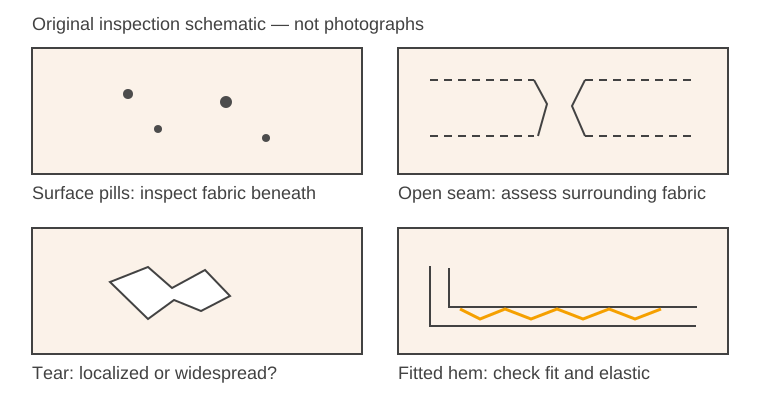
A stain, disliked color or change in texture is not automatically structural failure. Nor does a photograph establish whether a fabric will tolerate repair. Treat the illustration as a map of questions, not a grading scale. There are no original wear photographs or comparative wear-test results presented here; an illustration should never be mistaken for evidence of a brand’s durability.
Editorial reasoning: A working item does not fail merely because time passed. Structural damage, unmet fit requirements and feasible repair are separately inspected. This is an original decision aid, not a measured service-life threshold.
Keep, repair or replace: an original decision table
| Item | First check | Possible next step |
|---|---|---|
| Intact and fits reliably | Fabric, seams and elastic still serve their purpose | Keep and follow the current care label |
| Surface pills, otherwise intact [1] Maytag · Pilling involves loose or broken fibers forming knots; friction and laundering can contribute. General appliance-maker explanation; cannot diagnose a particular sheet’s damage or establish a lifespan. | Confirm that the issue is surface pilling, not holes or thinning | Keep or assess supplier-approved removal; stop if fabric damage is likely |
| Small localized open seam | Surrounding fabric remains sound and repair can restore function | Consider a suitable repair or ask a repair professional |
| Worn elastic, sound fabric | Verify correct nominal size and covered depth first | Assess whether this fitted hem allows a practical elastic repair |
| Widespread thinning or repeated tears | Damage extends beyond a sound local repair area | Replace the affected piece if useful function cannot be restored |
| Persistent fit mismatch | Check mattress footprint, topper/protector stack and supported fit | Correct the mismatch; repair or straps cannot invent missing fabric |
Repair feasibility is item-specific. No row promises a repair outcome, safety rating or measured remaining life.
Editorial reasoning: A working item does not fail merely because time passed. Structural damage, unmet fit requirements and feasible repair are separately inspected. This is an original decision aid, not a measured service-life threshold.
For a small seam repair, first decide whether the surrounding fabric can support stitching and whether the repaired area will remain comfortable. If you are unsure about the construction or the repair changes the fit, ask a suitable repair professional. Elastic may be enclosed, attached or integrated differently; replacing it is not equally practical on every fitted sheet.
Editorial reasoning: A working item does not fail merely because time passed. Structural damage, unmet fit requirements and feasible repair are separately inspected. This is an original decision aid, not a measured service-life threshold.
Separate fit problems from wear and care damage
A corner that slips immediately after adding a topper deserves a measurement check before an elastic verdict. Compare actual width, length and total covered depth with the product’s supported fit information. An originally wrong-size sheet is not fixed by calling it worn out. If the measurements are compatible, inspect installation and elastic before deciding whether replacement is necessary.
Editorial reasoning: A working item does not fail merely because time passed. Structural damage, unmet fit requirements and feasible repair are separately inspected. This is an original decision aid, not a measured service-life threshold.
Maytag explains pilling as fibers tangling into knots and identifies friction and laundering among contributors. Its care guidance includes checking labels and managing friction through suitable sorting and handling. That supports reviewing the routine, not claiming a damaged sheet can always be restored. Do not override a label with a generic high-heat cycle, bleach treatment or aggressive fabric shaver.
[1] Maytag · Pilling involves loose or broken fibers forming knots; friction and laundering can contribute. General appliance-maker explanation; cannot diagnose a particular sheet’s damage or establish a lifespan.
[1] Maytag · Maytag recommends checking care labels and reducing laundering friction with appropriate sorting and handling. Only label-compatible general prevention; no blanket temperature, cycle, additive or removal prescription.
Before a repair or replacement purchase
- Identify the affected piece rather than assuming the whole set failed.
- Confirm actual mattress dimensions and covered depth for persistent fit problems.
- Read the current care label and any supplier removal/repair instructions.
- Check whether surrounding fabric is sound enough for a localized repair.
- List usable flat sheets and cases that can remain in service.
- Compare the complete cost and required pieces without assuming a new set’s lifespan.
Editorial reasoning: A working item does not fail merely because time passed. Structural damage, unmet fit requirements and feasible repair are separately inspected. This is an original decision aid, not a measured service-life threshold.
Replace only what the decision supports
Hypothetical example: A hypothetical fitted-sheet problem
- Observation:
- One corner repeatedly slips; flat sheet and pillowcases are intact
- Inspection:
- Correct footprint and confirmed covered-depth fit, but visibly worn fitted elastic
- Check whether the hem construction and surrounding fabric permit an appropriate elastic repair.
- Compare that repair with replacing only the fitted sheet, if available in the required fit.
- Keep the intact pieces; if buying a set, count the extra pieces deliberately.
The decision concerns the fitted sheet’s function, not the age or supposed expiry of every piece in the set.
Use the replacement checker to organize these observations and the pilling tool when surface knots are the main issue. If replacement is justified and microfiber suits your preferences, verify exact size, depth, contents and care before selecting an Abeero Home set. Choose with your current needs, preferred feel and complete cost in mind; product lifespan varies and a longer-life advantage for Abeero Home is not established here.
Editorial reasoning: A working item does not fail merely because time passed. Structural damage, unmet fit requirements and feasible repair are separately inspected. This is an original decision aid, not a measured service-life threshold.
Put this into practice
- Assess your sheet with the replacement checker
Separate condition, fit and repairability so age alone does not trigger a purchase.
- Troubleshoot surface pilling before replacing
Review plausible friction contributors and supplier-approved care options without assuming the fabric has expired.
Common questions
Should sheets be replaced every one or two years?
This guide sets no universal deadline. Condition, useful function and repairability—not age alone—determine the decision.
Editorial reasoning: A working item does not fail merely because time passed. Structural damage, unmet fit requirements and feasible repair are separately inspected. This is an original decision aid, not a measured service-life threshold.
Does pilling mean the sheet has expired?
No. Surface knots and structural damage are different observations. Inspect the surrounding fabric before deciding on care, repair or replacement.
[1] Maytag · Pilling involves loose or broken fibers forming knots; friction and laundering can contribute. General appliance-maker explanation; cannot diagnose a particular sheet’s damage or establish a lifespan.
Editorial reasoning: A working item does not fail merely because time passed. Structural damage, unmet fit requirements and feasible repair are separately inspected. This is an original decision aid, not a measured service-life threshold.
Can worn fitted-sheet elastic be repaired?
Sometimes a repair may be practical, but hem construction, fabric condition and required fit must be assessed. There is no universal repair guarantee.
Editorial reasoning: A working item does not fail merely because time passed. Structural damage, unmet fit requirements and feasible repair are separately inspected. This is an original decision aid, not a measured service-life threshold.
Must I replace the whole set?
Not automatically. Keep sound pieces and replace what cannot serve its purpose; confirm what a new purchase actually includes.
Editorial reasoning: A working item does not fail merely because time passed. Structural damage, unmet fit requirements and feasible repair are separately inspected. This is an original decision aid, not a measured service-life threshold.
Will hotter washing fix damage or extend life?
No such outcome is established. Follow the current label and appropriate machine handling; aggressive care can be unsuitable and cannot recreate missing fabric.
[1] Maytag · Maytag recommends checking care labels and reducing laundering friction with appropriate sorting and handling. Only label-compatible general prevention; no blanket temperature, cycle, additive or removal prescription.
Editorial reasoning: A working item does not fail merely because time passed. Structural damage, unmet fit requirements and feasible repair are separately inspected. This is an original decision aid, not a measured service-life threshold.
Sources
- How to Prevent & Remove Fabric Pilling
Maytag · general guidance · Retrieved · Reviewed
- Pilling involves loose or broken fibers forming knots; friction and laundering can contribute.
- Maytag recommends checking care labels and reducing laundering friction with appropriate sorting and handling.
Requested manufacturer article read. No universal lifespan, replacement threshold, heat setting or fabric-shaver prescription adopted. No Abeero Home wear test.