
Abeero Home · Bedding guides
How to Measure Your Mattress for Fitted Sheets
Remove the sheets, measure the mattress width and length, then measure from the mattress bottom to the top of everything the fitted sheet will cover. Include a topper and any pad or protector that adds height. Compare that covered depth with the exact product’s supported mattress depth; a pocket seam measurement alone does not supply the same information.
[1] Casper · Casper instructs measuring mattress width, length and height including toppers, and measuring combined depth before buying. General measuring guidance, not proof of any Abeero Home variant’s fit.
Editorial reasoning: The first measures your bed stack, the second measures fabric construction, and the third is the manufacturer’s stated application limit. One measurement does not establish the other two.
In this guide
Prepare the bed and keep the frame out of the measurement
Take off the fitted sheet, blankets and pillows so the edges are visible. Have a tape measure and somewhere to record the values. Measure the mattress, not the outside of the bed frame, the height from the floor, or the dimensions printed on an old sheet package. Start by recording whether you are using inches or centimeters; changing units should not change the physical measurement.
[1] Casper · Casper instructs measuring mattress width, length and height including toppers, and measuring combined depth before buying. General measuring guidance, not proof of any Abeero Home variant’s fit.
If the topper hides the mattress edge, lift it temporarily to identify the bare mattress. Then put the layers back in their normal positions for a second, combined-depth reading. Record the separate and combined measurements as two ways of describing the same stack, not two quantities to add together. This makes later changes—such as removing the topper—easy to understand.
Measure width and length along straight paths
For width, run the tape horizontally across the mattress from one outside edge to the opposite outside edge. For length, measure from its head edge to its foot edge. Keep the tape straight rather than following the curved upholstery around a corner. Do not include a headboard, side rail or gap between the mattress and frame.
Write width and length in named fields; a bare “80 × 60” note can be ambiguous later. If measurements differ when taken at another position, record the range and ask the sheet supplier which intended-fit range applies. Do not average away a meaningful mismatch, stretch the tape to reach a familiar size, or round a custom mattress into a standard-size promise.
Measure the mattress, topper and protector
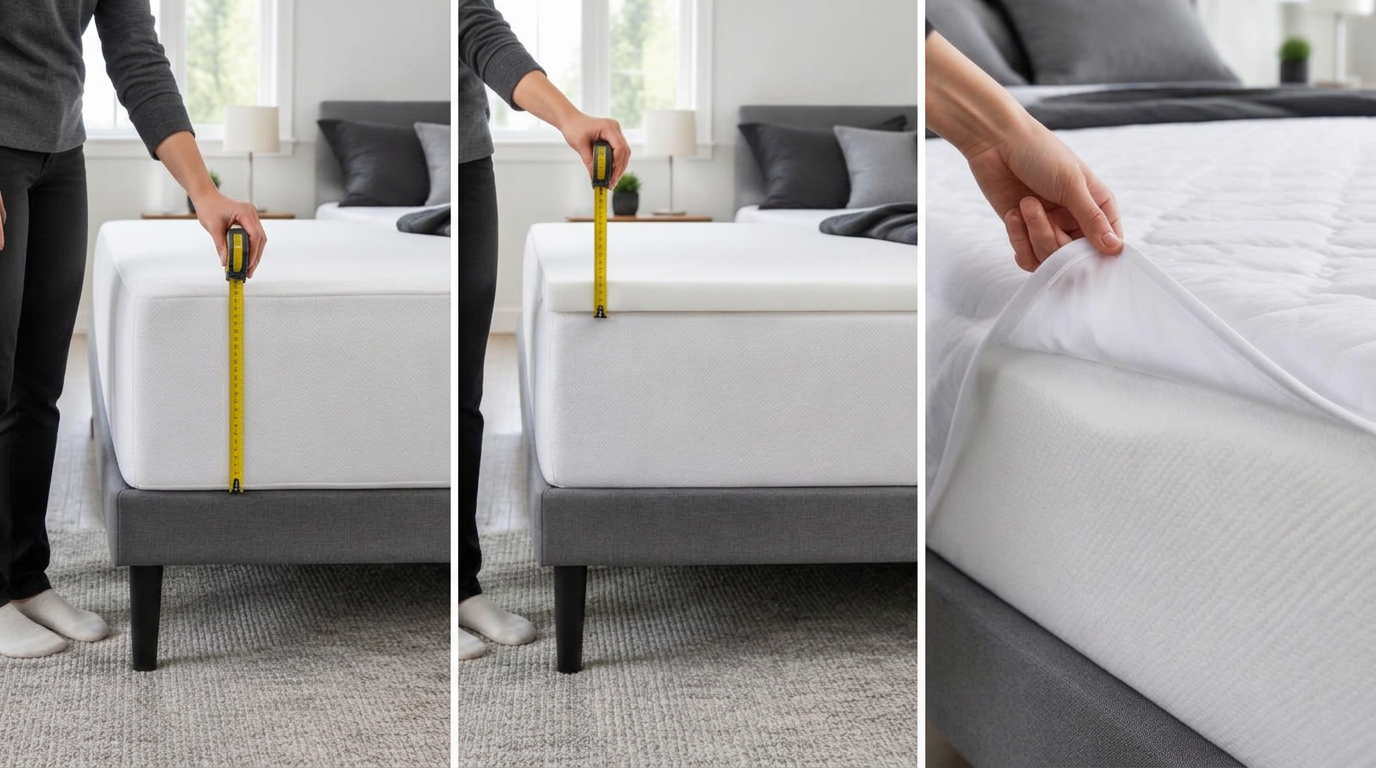
Measure bare mattress thickness vertically from the bottom mattress edge to its top surface, including an integral pillowtop. Do not count a removable topper as part of that bare reading. Measure the topper separately from its own underside to its top, in its normal resting position. A package label may describe nominal thickness, but your actual layer and its position are what you are recording.
For a pad or protector, identify whether it contributes a distinct raised layer under the sheet. Record that contribution without counting the mattress beneath it again. A loose fold of protector fabric held in your hand is not the covered height. If its effect is too small or uneven to measure reliably, record that uncertainty and use the assembled stack as a cross-check rather than inventing a fraction.
With everything positioned as it will be used, take the full vertical reading from mattress bottom to the highest surface the sheet will cover. Keep the tape beside the stack without pressing layers down to force a smaller number. If a crown or pad is higher than the edge, use a straight reference across that surface to locate its height. Note variations that a seller should assess.
Hypothetical example: A 14-inch mattress and 3-inch topper
- Bare mattress:
- 14 in / 35.56 cm
- Topper:
- 3 in / 7.62 cm
- Additional protector contribution:
- Not included in this two-layer example
- 14 + 3 = 17 inches of covered depth for these two layers.
- 17 × 2.54 = 43.18 centimeters.
- If a protector adds measurable height, add that contribution or remeasure the assembled stack; do not call it zero without checking.
17 inches is the two-layer measurement, not a recommended pocket seam size or a verified Abeero Home fit limit.
Calculation basis: Add non-overlapping layer thicknesses: 14 + 3 = 17 inches, or 35.56 + 7.62 = 43.18 cm. A separate protector contribution remains additional unless measured as none.
Compare with supported depth, not just a pocket seam
| Item | What it measures | How to use it |
|---|---|---|
| Covered depth | Your mattress plus covered layers | The depth the sheet must accommodate on your bed. |
| Pocket seam depth | A vertical seam in the sheet itself | Construction information; not an automatic supported mattress limit. |
| Supported mattress depth | The exact product’s stated intended application | Compare with the measured stack and the intended footprint. |
[1] Casper · Casper describes measuring the fitted sheet along its pocket seam for sheet height. Measures the sheet itself, not a tested mattress support limit.
Editorial reasoning: The first measures your bed stack, the second measures fabric construction, and the third is the manufacturer’s stated application limit. One measurement does not establish the other two.
For a concrete manufacturer-stated example, IKEA’s Queen RÖNNVECKMAL article 605.371.16 lists 60 × 80 inches and a maximum mattress thickness of 18 inches. A hypothetical 60 × 80 × 17-inch stack is one inch below that stated depth maximum. That comparison concerns this IKEA item only; it is not an independent test, a retention guarantee, or an Abeero Home specification.
[2] IKEA US · IKEA lists article 605.371.16 at 60 × 80 inches with maximum mattress thickness 18 inches. Manufacturer-stated example only; no independent test or Abeero Home fit claim.
Ask for the exact sheet’s intended mattress width and length, supported depth, and any applicable construction or use restrictions. If all you have is “deep pocket” or a seam measurement, the answer is still incomplete. There is no need to add a universal two-inch buffer, predict shrinkage or invent fabric stretch percentages. Those assumptions can make a tidy number less useful than an honest request for documentation.
Keep a usable record for the next decision
Before choosing a fitted sheet
- Width and length labeled clearly, with units.
- Bare mattress, topper and any pad/protector contribution recorded separately.
- Full covered-depth reading checked without counting the frame.
- Exact intended-fit footprint and supported maximum depth obtained.
- Unknown or uneven measurements noted rather than rounded into a guarantee.
Use the depth calculator to organize the stack, then the fit checker to compare it with documented limits. Abeero Home size labels alone do not complete that comparison; currently unverified exact-variant fit limits remain unconfirmed. A careful measurement can tell you what to ask for even when it cannot yet establish which product fits.
Put this into practice
- Compare your measurements with documented sheet fit limits
Check width, length and covered depth together; missing intended-fit evidence stays unconfirmed.
- Add your mattress, topper and protector depth
Keep each entered layer separate and see the total without an invented universal extra-depth buffer.
Common questions
Should I measure from the floor?
No. For sheet depth, begin at the bottom of the mattress—not the floor, legs, foundation or frame—and finish at the highest surface under the fitted sheet.
Does my topper count toward depth?
Yes, when it sits under the fitted sheet. Measure the combined mattress-and-topper height, or add separately measured non-overlapping layers.
[1] Casper · Casper instructs measuring mattress width, length and height including toppers, and measuring combined depth before buying. General measuring guidance, not proof of any Abeero Home variant’s fit.
Is a 17-inch stack guaranteed to fit a 17-inch pocket?
No. A seam measurement and a supported mattress limit are different. Obtain the exact product’s intended footprint and depth guidance instead of treating equal numbers as verification.
Editorial reasoning: The first measures your bed stack, the second measures fabric construction, and the third is the manufacturer’s stated application limit. One measurement does not establish the other two.
What if my protector is very thin?
Check the assembled stack and record uncertainty if its contribution cannot be measured separately. Do not measure a loose folded corner as thickness or silently invent a zero contribution.
Should I automatically add two inches?
No universal extra-depth allowance is used here. Record your actual stack and compare it with the supplier’s documented fit limits. A larger seam number by itself is not a fit promise.
Sources
- The Ultimate Bed Sheet Sizes Guide (with Sizing Chart)
Casper · general guidance · Retrieved · Reviewed
- Casper instructs measuring mattress width, length and height including toppers, and measuring combined depth before buying.
- Casper describes measuring the fitted sheet along its pocket seam for sheet height.
Only these statements are adopted. Generic standard/deep-pocket limits, stretch/fit assurances, comfort claims and dorm-default claims are not treated as universal or Abeero Home evidence.
- RÖNNVECKMAL fitted sheet, gray, Queen
IKEA US · comparative example · Retrieved · Reviewed
- IKEA lists article 605.371.16 at 60 × 80 inches with maximum mattress thickness 18 inches.
Manufacturer-stated example for this IKEA item only, not independent fit testing or an Abeero Home specification. Price, reviews, performance and care instructions are not adopted.