
Abeero Home · Bedding guides
How to Stop Sheets Tangling in the Washer and Dryer
To reduce tangling, load sheets loosely according to your appliance manual, give them room to move, and undo bunching before transferring them to the dryer. Choose only cycles and drying methods allowed by the fabric label. Large sheets can still roll into a ball, so inspect folds for dampness before storage. No sheet count, accessory or cycle guarantees a tangle-free load.
[2] Whirlpool · Whirlpool advises freely moving dryer loads, avoiding tight packing and sorting by fabric type and weight. General loading guidance; no sheet-count, minutes or complete-drying guarantee.
[3] Whirlpool · Whirlpool says large items including sheets may ball up; add loosely and remove bunching from washing. Dryer help guidance, not a claim that shaking prevents all tangling.
Editorial reasoning: Sheet dimensions, mass, fabric and machine design vary. Apparent dryness on an outside fold does not establish every folded area is dry.
In this guide
Begin with the washer load and manual
Read the loading instructions for your exact washer, especially how it handles large items and load balance. A front loader, an agitator machine and an impeller machine do not necessarily load alike. Follow the stated capacity and distribution instructions; do not wrap a sheet around a central component unless the manual actually directs that arrangement. If the machine signals imbalance, follow its stopping and redistribution procedure instead of repeatedly forcing the same load.
Editorial reasoning: Sheet dimensions, mass, fabric and machine design vary. Apparent dryness on an outside fold does not establish every folded area is dry.
Before starting, separate items whose labels, fabric handling, color behavior or bulk make them unsuitable companions. The load is not compatible merely because everything is white. If the instructions permit washing pieces together, add them without deliberate knots or a compact rolled bundle. Use the manufacturer’s loading guidance rather than compressing extra items into whatever space remains.
Editorial reasoning: Sheet dimensions, mass, fabric and machine design vary. Apparent dryness on an outside fold does not establish every folded area is dry.
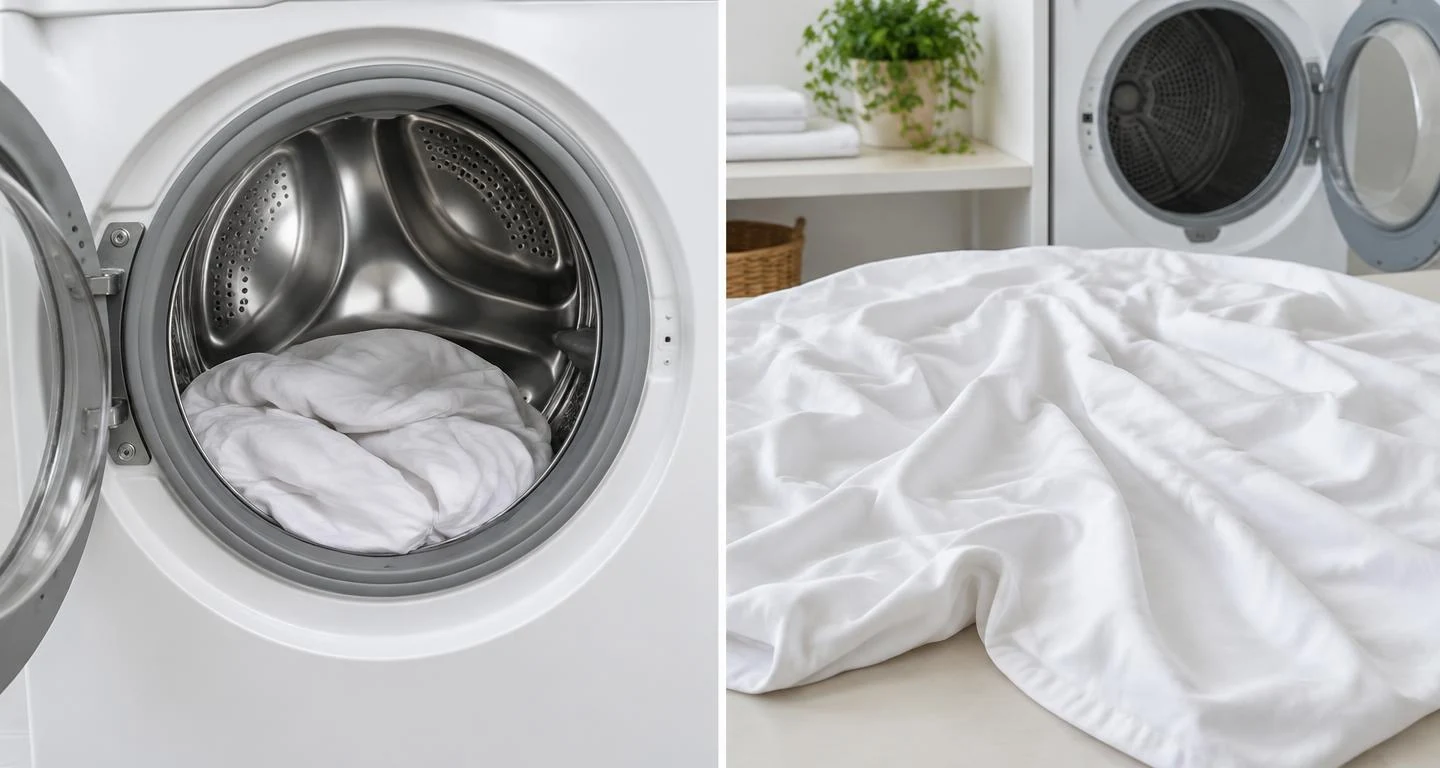
A bedding cycle is a possibility, not permission
Whirlpool describes a Bulky/Sheets cycle designed to help keep sheets from tangling. The same article says settings depend on fabric and recommends consulting the label. That does not establish that your washer has the cycle or that it meets a particular gentle-process or temperature restriction. Compare the manual’s description with the actual sheet instructions before selecting it.
[1] Whirlpool · Whirlpool describes a Bulky/Sheets washer cycle intended to help reduce tangling, with settings dependent on fabric and label. Manufacturer-specific description, not a cycle on every machine or permission to override delicate/cold restrictions.
If a named bedding cycle conflicts with the label, use a confirmed compatible option instead. If no suitable option is available, ask the fabric or appliance manufacturer about alternatives. A longer or hotter cycle is not an automatic cure for tangling. Nor should you invent a spin speed from a material name; use the controls and restrictions actually documented for the item and machine.
Editorial reasoning: Sheet dimensions, mass, fabric and machine design vary. Apparent dryness on an outside fold does not establish every folded area is dry.
Untwist before drying, then leave room to move
Once the washer has stopped and it is safe to unload, inspect the sheet for bunching. Whirlpool notes that large items can roll into balls in the dryer and advises adding them loosely after removing bunching from washing. Gently separate twisted layers before transfer; do not yank a thin or caught area. This is an opportunity to inspect damage and remaining stains as well as folds.
[3] Whirlpool · Whirlpool says large items including sheets may ball up; add loosely and remove bunching from washing. Dryer help guidance, not a claim that shaking prevents all tangling.
Editorial reasoning: Sheet dimensions, mass, fabric and machine design vary. Apparent dryness on an outside fold does not establish every folded area is dry.
Confirm tumble drying is allowed. Whirlpool’s dryer guidance says items should move freely rather than being tightly packed and recommends sorting by fabric type and weight for more even drying. The sheet label still controls heat and method. An accessory cannot make a forbidden drying method acceptable or compensate reliably for an overloaded drum.
[2] Whirlpool · Whirlpool advises freely moving dryer loads, avoiding tight packing and sorting by fabric type and weight. General loading guidance; no sheet-count, minutes or complete-drying guarantee.
Editorial reasoning: Sheet dimensions, mass, fabric and machine design vary. Apparent dryness on an outside fold does not establish every folded area is dry.
| Item | Adjustment | What it cannot establish |
|---|---|---|
| Load exceeds manual guidance | Reduce or redistribute as the manual directs | No universal one-, two- or three-sheet limit |
| Pieces require different handling | Separate incompatible items | Matching color alone does not settle compatibility |
| Sheet emerges bunched [3] Whirlpool · Whirlpool says large items including sheets may ball up; add loosely and remove bunching from washing. Dryer help guidance, not a claim that shaking prevents all tangling. | Untwist gently before permitted drying | Untwisting cannot guarantee no later balling |
| Dryer tightly packed [2] Whirlpool · Whirlpool advises freely moving dryer loads, avoiding tight packing and sorting by fabric type and weight. General loading guidance; no sheet-count, minutes or complete-drying guarantee. | Allow movement within documented loading limits | Visible room alone does not prove every area is dry |
| Folds still damp at the end | Separate and continue only a permitted drying method | A completed timer is not proof of dryness |
Editorial reasoning: Sheet dimensions, mass, fabric and machine design vary. Apparent dryness on an outside fold does not establish every folded area is dry.
Check the actual sheet before folding it away
Follow the appliance’s safe stopping procedure before checking a dryer load. Inspect folded areas and fitted corners, not just the exposed surface. If a damp bundle remains, loosen it and continue only with a method the label allows. Do not escalate heat beyond the restriction to meet a deadline. Fully dry the item before storage; if uncertainty persists, seek suitable fabric/appliance guidance rather than treating a finished cycle as a guarantee.
Editorial reasoning: Sheet dimensions, mass, fabric and machine design vary. Apparent dryness on an outside fold does not establish every folded area is dry.
Hypothetical example: A hypothetical bunched load
- Observation:
- Outer fabric feels dry; folded center remains damp
- Confirmed example label:
- Low tumble drying permitted
- Safely stop and remove the bunched sheet.
- Separate folds and reload loosely within the manual’s limits.
- Continue permitted low drying and inspect again before storage.
The decision is based on observed dampness and confirmed permission, not an invented extra ten minutes or a hotter default.
The drying checker helps separate permission from machine setting; the load planner uses entered weights and stated capacity. If tangling repeatedly accompanies error codes or unusual machine behavior, use the appliance troubleshooting guidance or service support. A new sheet set is not the default answer to a loading problem.
Editorial reasoning: Sheet dimensions, mass, fabric and machine design vary. Apparent dryness on an outside fold does not establish every folded area is dry.
Put this into practice
- Check the permitted drying method
Resolve tumble permission and heat restrictions before choosing a drying control.
- Plan the load against known capacity
Compare entered bedding weights and your machine’s stated limit without inventing a universal number of sheets.
Common questions
How many sheets can I wash at once?
There is no universal count. Use your manual, actual item sizes and weights, and the required fabric handling.
Editorial reasoning: Sheet dimensions, mass, fabric and machine design vary. Apparent dryness on an outside fold does not establish every folded area is dry.
Should I always choose Bulky or Sheets?
Only if your manual and sheet label make it compatible. Whirlpool describes an intended benefit, not permission for all fabrics.
[1] Whirlpool · Whirlpool describes a Bulky/Sheets washer cycle intended to help reduce tangling, with settings dependent on fabric and label. Manufacturer-specific description, not a cycle on every machine or permission to override delicate/cold restrictions.
Editorial reasoning: Sheet dimensions, mass, fabric and machine design vary. Apparent dryness on an outside fold does not establish every folded area is dry.
Will dryer balls guarantee no tangles?
No guarantee is established here. Any accessory needs compatibility with the item and appliance and cannot override loading or care restrictions.
Editorial reasoning: Sheet dimensions, mass, fabric and machine design vary. Apparent dryness on an outside fold does not establish every folded area is dry.
Why is the sheet damp after the dryer finishes?
Inspect for damp folded or bunched areas. A finished cycle alone does not establish complete dryness; follow permitted drying and appliance guidance.
[3] Whirlpool · Whirlpool says large items including sheets may ball up; add loosely and remove bunching from washing. Dryer help guidance, not a claim that shaking prevents all tangling.
Editorial reasoning: Sheet dimensions, mass, fabric and machine design vary. Apparent dryness on an outside fold does not establish every folded area is dry.
Can I use high heat to finish a tangled load?
Not if the label prohibits it. Untwist safely and continue only a confirmed permitted method.
Editorial reasoning: Sheet dimensions, mass, fabric and machine design vary. Apparent dryness on an outside fold does not establish every folded area is dry.
Sources
- How to wash sheets
Whirlpool · general guidance · Retrieved · Reviewed
- Whirlpool describes a Bulky/Sheets washer cycle intended to help reduce tangling, with settings dependent on fabric and label.
Requested article re-read. Generic heat and cycle recommendations do not override fabric or exact-machine restrictions.
- Properly Loading a Dryer
Whirlpool · general guidance · Retrieved · Reviewed
- Whirlpool advises freely moving dryer loads, avoiding tight packing and sorting by fabric type and weight.
Product-help text read. No universal sheet-count capacity, drying time or Abeero Home heat setting.
- Sounds or Noises in a Dryer
Whirlpool · general guidance · Retrieved · Reviewed
- Whirlpool says large items including sheets may ball up; add loosely and remove bunching from washing.
Product-help guidance read; no guaranteed tangle prevention or numeric capacity inferred.